
The Fenway Memory Project and the importance of place
By Steven Davy
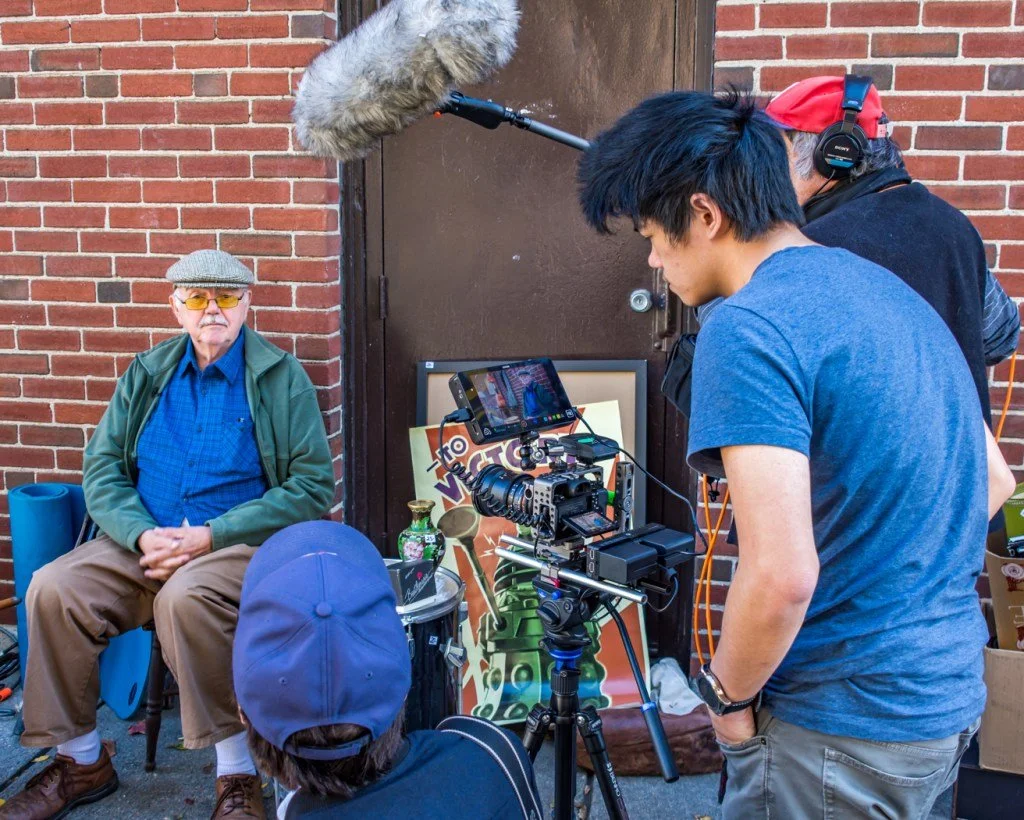
An interview taking place for the Fenway Memory Project. (Courtesy of Timothy Ney, bitsandflow.com)
The Fenway neighborhood has seen a dramatic evolution both in the built environment and in the residents. For many who have made Fenway home will often note how different Boylston Street looks from even five or 10 years ago.
“ Oh my God, look at Boylston Street. That's mammoth change,” said longtime resident Arthur Rose who at age 104 may have witnessed more change to the neighborhood than most.
Rose was interviewed as part of the Fenway Memory Project, an effort by producer Timothy Ney to document, mostly through oral histories, video and photography, the neighborhood’s people, character and history. What began in 2017 has evolved and framed its focus around four geographical areas as central to the retelling of Fenway’s history.
Ney noted the sites include the Fenway Victory Gardens, the Fenway Health Center, the former Machine Nightclub — now where the Bon apartment building is located on Boylston St. — and Symphony Road.
In particular, the Fenway Victory Gardens could serve as the beating heart to the Fenway Memory Project. With over 500 plots located in Frederick Law Olmsted’s Emerald Necklace, the gardens span 7.5 acres. Importantly the Gardens, the oldest victory gardens in the country, are a gardening home for hundreds of Bostonians and visitors from around the world.
Ney interviewed Rose for the Fenway Memory Project in Rose’s victory garden plot. The elder statesman reflected on the historic gardens and the sense of community. “There's a constant parade and that's what I like about this garden,” he said. “I have the constant parade going by with different looks and different people … I think it's very interesting. And some of them stop and talk.”
It’s these one-of-a-kind oral histories that Ney and his team have collected over the years of the project. Ney, also a gardener at Fenway Victory Gardens, didn’t know much about tilling the land when he got started, but relied on his neighbors for a gardening education. This in turn planted the seeds for the Fenway Memory Project.
“I got to talking to the older gardeners — what do I plant and when, how do I garden, and found out what it used to be like and how it’s changed,” Ney said. “It seemed like rich material.”
The Memory Project has over 30 hours of interviews (watch a trailer of the Project here). Ney and his team, which has included students from Simmons, Berklee, Emerson, BU and Northeastern, have recorded interviews at the Morville House, in gardens, apartments and also have used the PRX Podcast Garage. Ney said it’s been “really rewarding.”
Pearl Lung, editor of the Fenway Memory Project, also described the depth and richness of the stories they recorded of the park and the neighborhood. “It’s interesting to listen to the residents,” Lung said. “The neighborhood has changed drastically from the [19]70s to now.”
That change, from all the developments have had both positive impacts, but also have forced many residents out because of gentrification. “Some of the residents pushed out had lived here for decades,” Lung said.
The Fenway Memory Project has elicited stories about corner stores or long since shuttered restaurants. These artifacts of history are a part of the fabric that makes up the neighborhood. While some aspects of Fenway are physically gone, the decades of fighting to preserve the Fenway Victory Garden stands out as a testament to the community.
“The survival of the Victory Gardens, in particular, sheds light on the perseverance and longevity that can ultimately be found within our historical neighborhood,” Ney wrote in an email. “... We hope that those who hear the Fenway Memory Project stories will be inspired to join in on preserving this piece of history alongside natural spaces.”
Ney and his team are working on an immersive website experience for the Project. But he also wants the Project to continue to grow and evolve just like the neighborhood.
If you are a gardener in the Fenway Victory Gardens, Ney would like to hear your story. Send an email to bitsandflow@gmail.com.